

Red, white and Asian sauces all fall under sauce production, but each product places different demands on process design. The deciding factors are product composition and structure: pH value, salt content, viscosity source and particle structure. For sauce manufacturers selecting process equipment, expanding their line or scaling up, these properties form the starting point for technical decisions: from material selection and heating method to the choice between continuous and batch production. Mayonnaise requires its own approach. As an emulsion, its composition differs fundamentally from béchamel sauce and cream sauce, for example, and other, sometimes more efficient, production routes are possible.
Product composition determines process design
The combination of pH value, salt content, viscosity source and particle structure is the starting point for every technical choice in the process line. Together, these factors determine which material, which type of heat exchanger or cooking kettle, and which process control are suitable for a specific sauce.

pH value and chlorides determine material selection
Red sauce
Red sauces are based on tomato concentrate, tomato purée or fresh tomato, supplemented with vegetables, herbs and sometimes meat. The pH is usually between 3.5 and 4.5. At this pH, organic acids are well manageable for AISI 316L. The corrosion risk mainly increases when acidity is combined with salt and high process temperatures. AISI 316L is therefore the standard; at higher salt contents or temperatures, duplex 1.4462 may be the better choice.
White sauce and mayonnaise
White sauces, such as béchamel and cream sauce, are often based on dairy, fat and a thickener, usually starch. The pH is often between 5.5 and 7.0, which means corrosion is in many cases less decisive than with acidic or salt-rich sauces. Mayonnaise is a separate product category. As an emulsion with a pH of typically 3.6 to 4.2, it requires its own assessment of recipe and process control. For material selection, the combination of acetic acid and chloride is the main factor.
Asian sauce
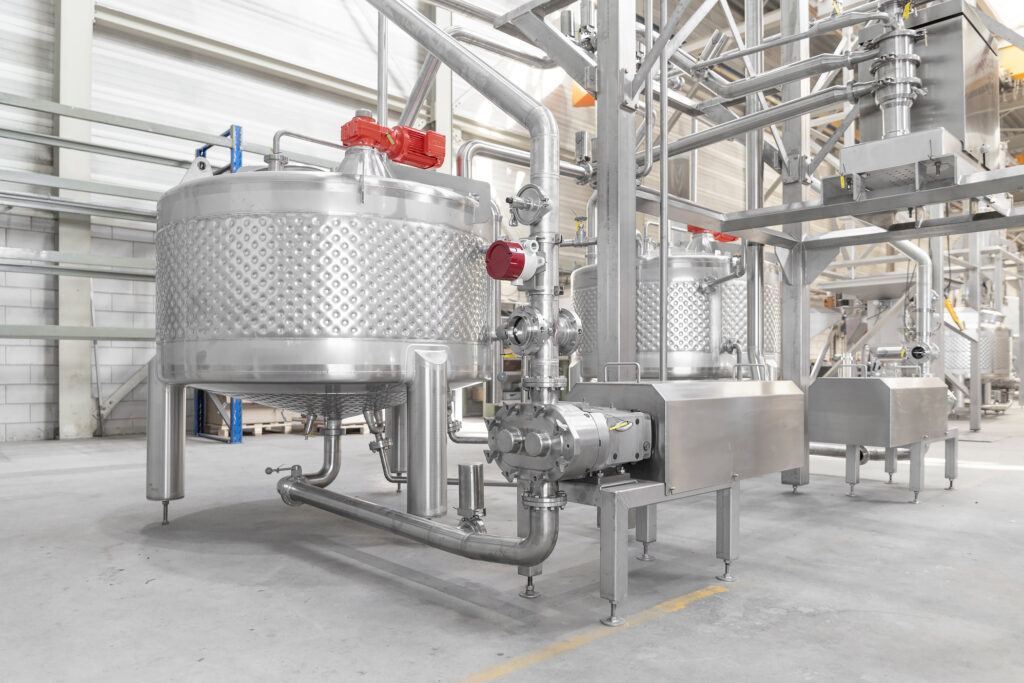
Asian sauces often contain soy, with salt contents that can reach 12 to 18%. Combined with a cooking process, the chloride load can become too high for AISI 316L, with a risk of pitting and crevice corrosion. Above approximately 60 °C, the risk of stress corrosion cracking also increases. In these situations, duplex stainless steel is recommended: its higher chromium and nitrogen content gives it greater resistance to chloride-induced corrosion. For example, we recently delivered an 8.5 m³ cooking kettle for the production of soy-based sauces, with both the kettle and the anchor agitator made of duplex 1.4462.
Material selection based on product composition and structure
| Sauce type | Typical pH | Salt content | Main corrosion risk | Common material selection |
|---|---|---|---|---|
| Red sauce (tomato) | 3.5–4.5 | Low to medium | Acidity combined with chloride and temperature | 316L (1.4404); duplex 2205 (1.4462) at high temperature/salt |
| White sauce (béchamel, cream sauce) | 5.5–7.0 | Low to medium | Low; mainly cleaning agents (CIP) | 316L (1.4404) |
| Asian sauce (soy-based) | 4.5–5.0 | Approx. 12–18% | Chloride-induced pitting, crevice and stress corrosion | Duplex 2205 (1.4462); super duplex or 6Mo when heated |
| Mayonnaise | 3.6–4.2 | Approx. 1–2% | Acetic acid combined with chloride | 316L (1.4404) |
The optimal material selection depends on the exact product composition, pH, chloride content (from salt, process water or cleaning agents), temperature and residence time. The cleaning procedure also plays a role. Strongly alkaline or acidic cleaning agents, chlorine-based disinfectants, and their concentration, temperature and contact time can increase the corrosion risk. Material selection should therefore always be assessed per application.
Process line design: continuous processing versus batch production
Red sauce production lines usually consist of several process steps, including ingredient dosing, heating, homogenisation where required, pasteurisation and buffering. For smooth sauces such as ketchup, a homogeniser or colloid mill can be used. For sauces with coarse particles, homogenisation can be omitted to avoid damaging the particles. Another option is to mix and smooth the sauce base first, so the binding ingredients are properly absorbed, and add the larger particles afterwards.
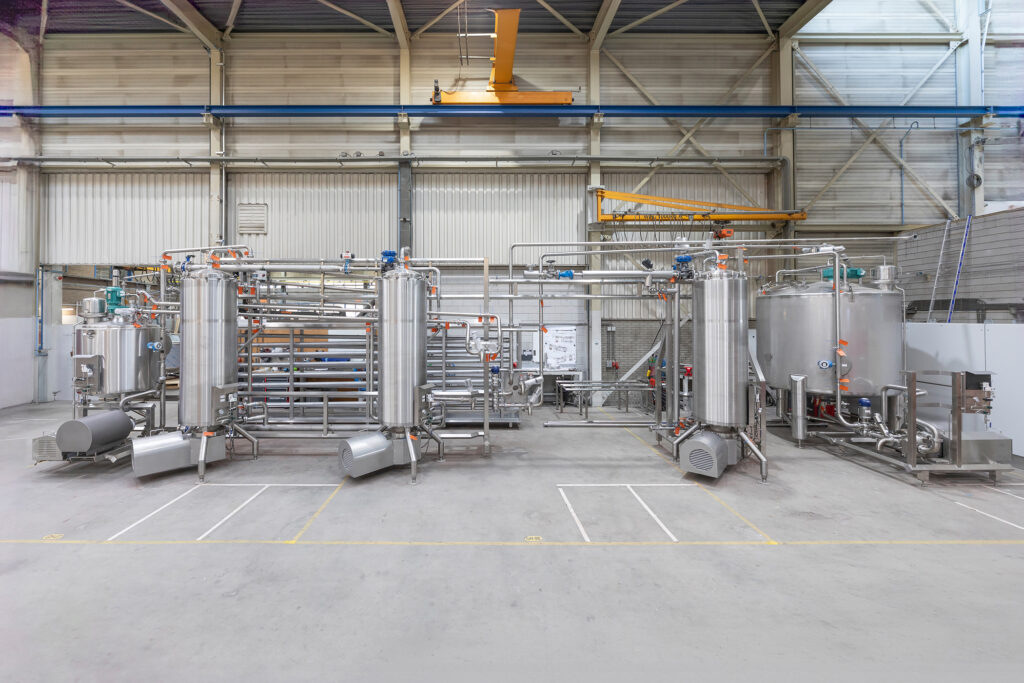
Continuous processing with a Kelstream® scraped surface heat exchanger is particularly interesting at higher production capacities. It allows precise control of residence time and temperature, which helps maintain consistent product quality and limits mechanical stress on the product. One example is the red sauce line with a capacity of over 4,000 kg per hour that we built for a producer in the Caribbean. There, three Kelstream heat exchangers handle heating to pasteurisation temperature and two-stage cooling. Depending on the product and process conditions, this approach can also improve energy efficiency per unit produced. For sauces with solid particles, heat penetration to the core of the particles must also be taken into account to determine the required time and temperature.
Continuous production is also used for mayonnaise and other emulsified sauces, but batch production remains a suitable option as well. It offers more flexibility when recipes, production volumes or customer requirements vary. In a continuous bulk process, specific ingredients can also be added just before pasteurisation and filling. This keeps the product base consistent during product changeovers and reduces product loss and cleaning time, as only the last part of the process line needs to be changed over.
White sauces are often produced in batches, as the process sequence fits well with the use of a jacketed cooking kettle: melting the fat, adding the starch, gradually mixing in the liquid and precisely controlling the heating. Modified starches can simplify processing, but temperature and heating time remain important for achieving the desired texture. Asian sauces, which often contain a larger number of ingredients, are also regularly produced in batches.
For white sauces, direct steam injection can result in a whiter end product thanks to rapid heating. However, the different heating profile can affect starch performance, so a different or specifically suitable starch may be needed. The steam condenses in the product and adds water, which must be accounted for when determining the recipe and final consistency.
The choice between continuous processing and batch production is therefore not universal. Continuous systems usually require a stable supply of ingredients and a fixed recipe. Batch production offers more flexibility with varying recipes, smaller production volumes and changing customer requirements.
Technical considerations in sauce production
When scaling up a sauce production process, heat transfer behaviour changes. In larger kettles, the surface-to-volume ratio decreases, which can lead to longer heating and cooling times. For starch-based white sauces, the gelatinisation profile must therefore be revalidated at the intended production scale. This confirms whether the desired viscosity and texture are consistently achieved at larger volumes.
For red sauces with a high solids content, viscosity can increase during heating, reducing heat transfer efficiency. The agitator design, heat exchanger sizing and pump selection must therefore be carefully matched to the product. Positive displacement pumps are often suitable for sauces with particles, as they can handle viscous products and, when correctly selected and operated, limit mechanical stress.
Colour retention is also an important consideration in red sauce production. Lycopene and other pigments can be affected by exposure to oxygen and by process conditions. Closed systems, suitable storage conditions and limiting unnecessary exposure to high temperatures help preserve product quality. Direct steam injection can also affect the colour of tomato-based products. In some applications it produces a brighter colour, but the result depends on product composition and process conditions. The additional water from condensing steam must also be included in the recipe calculation.
For white sauces, excessive or prolonged heating can cause discolouration, partly due to the Maillard reaction. Precise control of temperature, heating time and mixing is therefore important to achieve the desired colour and consistency.

Hygiene, CIP and food safety
Both red and white sauce production lines require hygienic design in accordance with applicable food industry requirements and relevant EHEDG guidelines. However, the main cleaning challenges differ per product group.
Red sauces can cause deposits consisting of sugars, fibres and colourants, especially during heating. The cleaning programme must be matched to the type of fouling and may consist of an alkaline cleaning step, followed by an acid step where needed to remove mineral deposits. Additional cleaning agents are only used when they are suitable for the fouling in question and compatible with the materials and seals of the installation. The acidity of the product and the concentration and temperature of the cleaning agents also affect the corrosion load. Mineral deposits can also form due to water hardness, heating and interactions with organic acids.
White sauces can leave a stubborn layer of starch and proteins on process surfaces, especially after cooling and starch gelatinisation. Effective cleaning therefore requires sufficient mechanical and thermal action. For sauces containing raw egg or unpasteurised dairy, extra attention to microbiological risks is also needed.
Dead zones in tanks and piping must be avoided. Well-positioned tank cleaning nozzles or spray balls, correct pipe slope and an adequate combination of CIP pressure and flow velocity are essential for effective cleaning. These parameters should be considered together when designing and validating the cleaning process.

Conclusion
The technical challenges in red sauce production are selecting suitable materials based on acidity and chloride content, preserving particle structure, and controlling heating to achieve the desired product quality and food safety.
For white sauces, the focus is on controlling starch thickening during heating, precisely regulating heat input and cleaning the installation effectively. Direct steam injection can offer advantages, including a potentially whiter end product, but its effect on starch performance and the product’s water content must be taken into account.
Asian sauces require particular attention to the chloride resistance of materials, especially when high salt concentrations are combined with high temperatures and long cooking times. Duplex stainless steel can be a suitable choice in such applications, but material selection should always be based on the actual product and operating conditions. Sauces with a high vinegar or acetic acid content can also pose corrosion risks.
In all cases, the complete process line should be treated as one integrated system, from ingredient dosing to final packaging. Equipment selection, heating method, pump design, cleaning procedures and production scale together determine the reliability and performance of the production line.
With our extensive experience in the food industry, we understand the challenges of producing a wide range of sauces. We are happy to advise you on optimising, renewing or making your production process more sustainable with tailor-made process equipment and solutions. Whether you need a complete process line or a single component, we work closely with you to develop a solution that fits your product and process.